Daycares affected by move to online teaching in light of COVID-19

By Carolina Molina and Brianna Smith

Metropolitan Family Services Learning and Wellness Center, a daycare in East Englewood, is government funded with additional funding from DCFS. They have three centers throughout the city. 

Map: Locations of all of the Metropolitan Family Services, Ladybug & Friends, and Kimball Daycare Centers

Funding is a large part of how Metropolitan Family Services Learning and Wellness Center implements its policies given the lack of parent tuition and the presence of programs that use government funds. According to the 2017-2018 Head Start Annual Report, they receive both private and public funds. 

In terms of public funds, Metropolitan Family Services receives $6,287,229 from the City of Chicago and $232,938 from the State of Illinois. Private funds come from In-Kind in the amount of $17,667,  Foundations/Individuals/Corporations in the amount of $39,000, and client fees in the amount of $115,538. 

The company receives funding for having a Head Start Program. Enrollment depends on whether the family meets certain criteria regarding their income and employment status among others. 
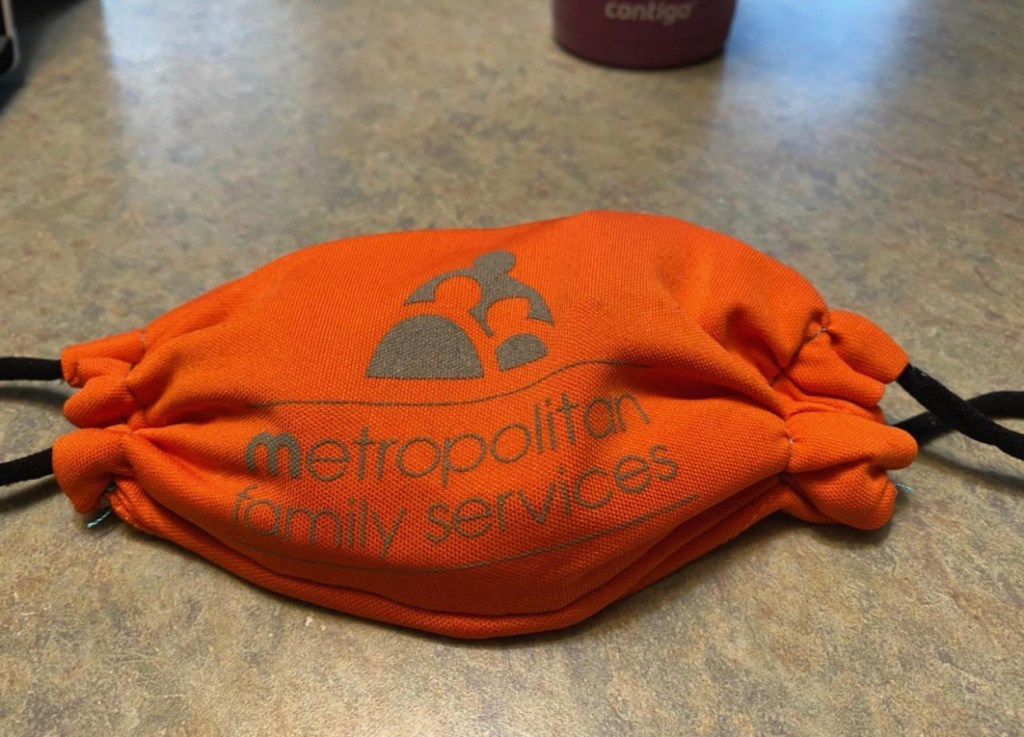
A mask with the Metropolitan Family Services Logo. `Photo/ Metropolitan Family Services Learning and Wellness Center

During the COVID-19 pandemic, Metropolitan Family Services Learning and Wellness Center has all three of its centers closed down. According to Ahyshia Faines, teacher at Metropolitan Family Services Learning and Wellness Center, they applied for a new license to open up two of their centers to be emergency centers for essential workers, but did not receive it because it would have affected their funding. 

“As a result we have supervisors and supervisors have supervisors to ensure that everyone is doing their jobs properly,” Faines explained. “There are so many people that are there to make sure we are in line with our funding and funders can make unannounced visits and can check online to see how the center is doing. They often do weekly visits.”

The funding for the Learning and Wellness Center has not been affected as a result of COVID-19. The manner in which the curriculum is implemented has shifted and is now more reliant on parents. 

“We are using My Teaching Strategies which is a website and app,” Faines explained. “We use [the] Remind App to communicate through text and we are emailing a few times a week. Once I pick a few activities I send it through the website. I then let parents know to check their emails for any resources we sent. On Mondays we do check-ins and talk to the parents about the activities.” 

“We use a planning guide,” Faines stated, “We don’t do this at random; we plan everything to match up to the objectives we are trying to observe and rank for each child.”

Venngage: In-Class Learning Compared To Online Learning

Ladybug & Friends Daycare and Preschool, a private daycare in Edgewater, a North Side neighborhood in Chicago relies entirely on parent tuition to fund their centers. Their policies are finalized by upper management with little to no parental influence. 

The Ladybug & Friends Daycare and Preschool company has five locations throughout the city and is fully funded by the tuition parents pay weekly. Tuition rates depend on the age group of the child with infants being the most expensive at $444 per week.

“The funding goes from the parents to the owners and from them,” said Andrea Urbina, 30, the director of the Edgewater location of Ladybug & Friends, “We get [funding] for the curriculum and materials. For a very short period we were given a budget, but after that we’ve never really had one, so we just purchase what is necessary after getting approval from the owners.”

The second Ladybug & Friends Daycare & Preschool to open in Chicago. It is located on the North Side in Edgewater. Photo/ Steven Johnson Photography – Ladybug-daycare.com

During the COVID-19 pandemic Ladybug & Friends Daycare and Preschool transitioned most of their activities online. Teachers send out daily videos and have been doing Zoom meetings to make sure the children have the best education they can during this pandemic. The daycare stays in contact with the parents as much as they possibly can. All videos and activities from teachers are sent to their directors and the directors send them out to parents in order to keep the teachers’ contact information private. 

“Our teachers have been amazing at keeping up with their videos and doing Zoom meetings and adapting the best they can to doing the most they can at home for all our kiddos,” Urbina stated, “We are very proud of our teachers.”

The curriculum is being followed closely and was given to teachers as the basis of the educational videos they are creating.  

Ladybug & Friends is working closely with officials to open an emergency center for first responders and other essential workers. Their main concern with this involves their ability to staff the center appropriately, as opposed to having funds be an obstacle.

Funding has become a concern for Ladybug & Friends given that they pay their employees using the funds provided by tuition. As a result of the closures, parents are no longer paying tuition. The owners of Ladybug & Friends have opted to apply for COVID-19 Relief for small businesses. Payment for Ladybug & Friends employees relies on this loan. 

Until this loan is approved, the teachers at Ladybug & Friends have donated their time to create academic videos and worksheets to send to their students independently. 

Kimball Daycare is also a daycare on the North Side of Chicago. It is funded by parent tuition and the Childcare Development Block Grant Program. This grant provides daycares with funding for institutions that have programs like Head Start and Action For Children.

Programs like these, in addition to parent tuition, have a large influence on their enrollment. 

“Head Start and Early Head Start Program are programs Kimball Daycare provides to help low income families with very young children,” explained Erhyn Ortiz, 24, a teacher at Kimball Daycare. “The Early Head Start Program promotes physical, cognitive, social, and emotional development of infants and toddlers through safe and developmentally enriching caregiving.” 

Kimball Daycare has also closed as a result of the COVID-19 pandemic, but like other daycares they remain available to parents and kids using tools like Zoom. 

“Our daycare center is closed,” explained Ortiz. “We provide parents with online activities and every week we check on the children and families to see if they need our help or support. We are using the Dojo App to post videos and send activities every week to parents. We also do lesson plans and news letters every week as well as paperwork, Q&As, and checkpoints as a part of teaching strategies for the Creative Curriculum.”

More parents are turning towards online resources to keep kids on track with their educational objectives. Several websites like My Teaching Strategies have a curriculum with activities that are accessible to parents at this time. 

Kimball Daycare is also using a government program to fund the payments of their employees’ salaries. There has been no change to the teachers’ salaries as a result of the COVID-19 closures, but the center is no longer being partially funded by parent tuition. 
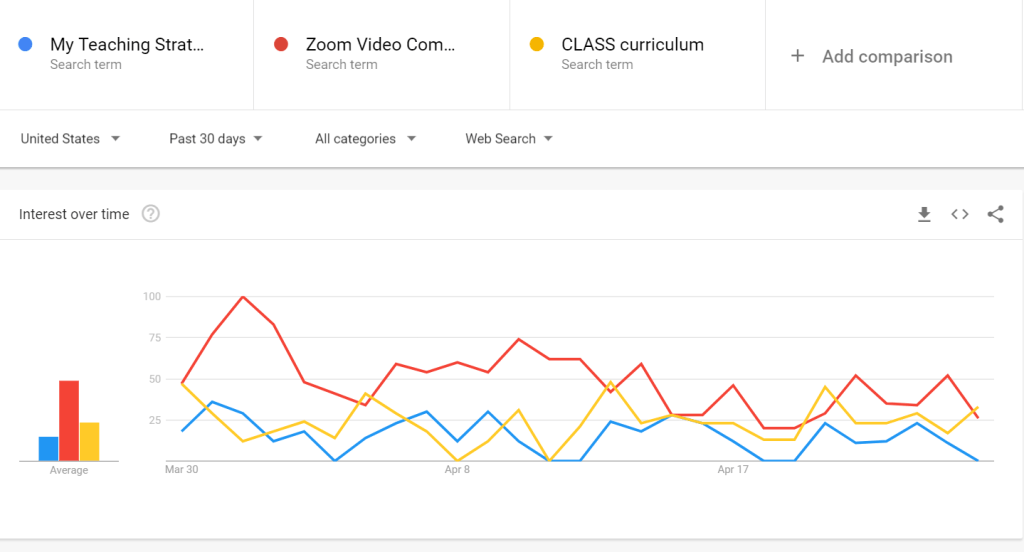
According to a Google search analysis, Zoom, My Teaching Strategies, and CLASS Curriculum have all been more searched for in the past 30 days than the past year. Zoom has been the most popular online tool that has been searched for. All three daycares use Zoom to continue implementing their curriculums and continue communications between teachers, administration, and parents. 
How the COVID-19 Quarantine Affects Essential Workers, CPS, and Others in Chicago

By Zirah Wadley, Carolina Molina and Ludmila Pesce

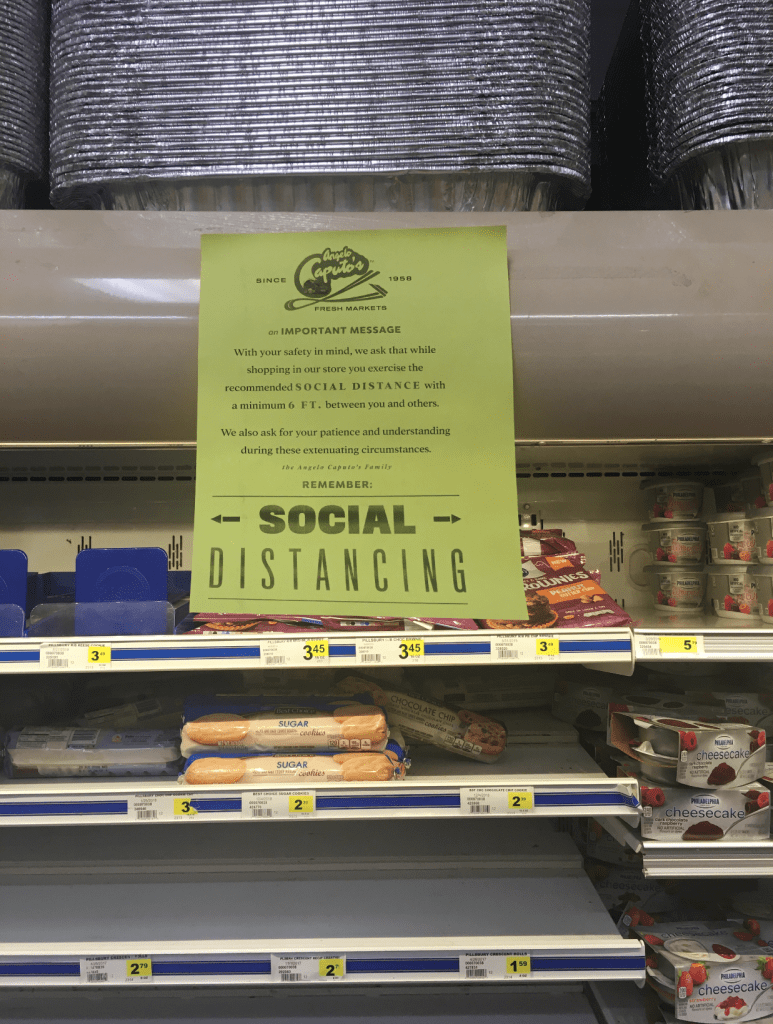
Sign at Angelo Caputo’s Fresh Markets reminding customers to practice social distancing. Photo/ Ludmila Pesce

“But as of recently, I am not 100% completely satisfied with working from home. Since COVID-19 started, working from home has been a little bit difficult for me. When I ship a package, I normally take public transportation so that I am able to ship the package on time to my customer. But I am now trying to minimize the amount of time I spend outside even if it’s just to ship a package. ” – Myka Westmoreland,  19 , an Etsy Seller Online.

On April 13, Illinois Gov. J.B. Pritzker executed a stay-at-home order for all Illinois residents, and at the time Chicago Mayor Lori Lightfoot predicted the order would extend into May. 

Flourish: States With The Highest Amount of Coronavirus Cases

“I am vegan-vegetarian. I have the advantage to look and find lots of vegetables and fruits in the store. I rarely eat junk food. But when it comes to cleaning supplies, no I am not satisfied because it’s hard to find any. Even before this pandemic I’ve always gone shopping for groceries once a week so I could have food in my fridge that could last me a week. ”

During this pandemic, many stores have been running low on certain foods and toiletries. Eggs, milk, tissue, and meats are all in low stocks currently. Some stores have given customers a limit of buying a multitude of certain items just so everyone can have their fair share. 

“I recommend people to stop hoarding food because stores will eventually restock,” Westmoreland proclaimed

“All homes should be prepared with — but not hoard or stockpile — a sufficient amount of key household items and groceries in case they need to stay home for a period of time,” said Dr. Chloë E. Nunneley, a resident in the ABC News medical unit explained. 

Sign at Tony’s Fresh Market asking customers to limit their purchases of paper products to ensure that everyone gets the products they need. Photo/ Ludmila Pesce

Additionally, “There is absolutely no concern about running out of food,” The National Grocers Association announced on March 17th.    

NGA President and CEO Greg Ferrara said “independent grocers are helping larger chains meet demand during this time, and that grocery stores are being restocked at unprecedented speeds.”

When traveling to the grocery store or any store in general, Westmoreland explains that she is nervous being in public spaces. “ Not because of the virus itself, but because of the people around me. This pandemic has made a lot of people think irrationally which leads to making irrational decisions like saying outlandish things to others or acting out in public.”

Map: Grocery Stores With Social Distancing Policies

“I see it every day mostly, in my girls that they had a routine and they were able to socialize and now they do have each other, but I can tell they miss their routine and I do miss my own routine,” said Lizbeth Chacon, 30, a parent of twin girls who is now working from home.

“They have gone to daycare since they were about 3 months old so this quarantine has kept us all inside and I do work from home currently without having hired help to watch my girls, but I do count on my mom and my sister who have been very helpful,” she explained. 

Childcare has been a concern for parents that are still working during this time. Parents with kids in daycare are having to find someone willing to watch their kids while they either leave for work or need to step into another room to get their work done from home. For Chacon, it wouldn’t be prudent to have a babysitter come in everyday to watch her kids for fear of that person potentially being a carrier. 

“We try to minimize the amount of times we go out to stores or in public because one of my twins is asthmatic and my mom is a breast cancer survivor so their immune systems are compromised,” said Chacon. 

“It’s been challenging, working from home and having my girls around. The work I do I have to manage other employees so it’s not an easy job to do every day,” she continued, “Being in quarantine, and I’m sure other people are going through the same, brings different feelings and when I do have Zoom meetings with my staff everyone is excited to see each other and it makes me miss our routine.“

Timeline: COVID-19 Cases In Illinois

I get by like a normal day at work. Just simply doing the same old stuff, and since I work in a factory where shipping and handling is a big factor, I do not feel safe due to the fact that the trailers I work in are not clean.” — Trevon Nelson, 22, an essential worker at FedEx. 

On April 13th,  Chicago Tribune article, essential workers have filed complaints about the lack of action being taken on safety measures. At Jewel Osco in the Chicago area, pharmacists complained of insufficient staffing and personal protective equipment. Some have said that they were told to remove their masks when interacting with the public. 

Teamsters Local 727 filed a grievance against Osco Drug demanding it do more to reduce the risk of virus exposure. The company later installed barriers at pharmacy counters, improved communication and instituted bonus pay.

“I keep myself protected by doing what I can to make sure I’m safe. Basically, dressing according to the weather. The weather here is bipolar. I also do wear gloves when I am on duty. As far as benefits go, the closest thing I got is a $2.00 raise because of the pandemic. I went from earning $14.75 to $16.70 working at FedEx,” Nelson explained. 

This, however, is not always the case. 

“We’re not given any benefits,” said Renato Lopez, 32, an essential worker at SWD INC., “I don’t get any overtime anymore. I can only work 40 hours maximum. I used to start a half hour early, but now I’m starting an hour later.

“I have to try to not have contact with anyone because we’ve had 3 confirmed cases and two pending in the last two weeks. The company I work for processes parts that go into respirators that are needed to help with COVID-19 so they can’t just shut down. They’re implementing a new policy to take everyone’s temperature upon arrival before punching in.” 

He makes his understanding clear that even though he’s not getting benefits, his work is very important.

The cases at work have brought up concerns about his exposure and how that might affect his family. While some healthcare workers are isolating themselves from their loved ones to avoid potentially spreading the virus, Lopez shares the childcare duties with his wife, who is also working at this time. 

“It’s made simple things more trivial like when coming home I don’t say ‘Hi’ to my girls or my wife,” Lopes stated,” I go straight into the shower and I disinfect anything I touch to keep them safe.” 

“We have to follow the CDC cleaning guidelines with the work equipment, my shoes, my car, my clothes, and even the hat I wear,” Lopez added,” I have to keep my mask on all day and sometimes we have to move really heavy materials and it makes it hard to breathe when it gets too hot. It’s a bit hard and using the mask tires me out faster, but I guess at some point you get used to it.” 

Datawrapper: Confirmed Cases In Illinois

CPS Community 

Back in the middle of March, Pritzker implemented a statewide school closure to halt the spread of the rapidly growing COVID-19. On April 17, Pritzker extended the school closure for the rest of the 2020 school year, meaning that students and teachers of CPS will continue to rely on remote learning tools and resources.

There has been mixed emotions on the announcement. Michelle Moore, whose two children attend Sayre Language Academy, notes that with the school close, it has a great impact on her children’s education. 

“Because both my children have IEP, they get services that I wouldn’t be able to offer at home … [and] both have benefited from [them],” she said.

Moore’s two children were provided with packets containing their assignments, encouraged to read each day, utilize IXL Learning, and have access to Google Classroom to keep up with assignments and reach out to their teachers for help.

Even so, keeping up with their assignments can be tedious and Moore encourages them to continue their assignments on a daily basis. 

“‘[Be]cause if I don’t do that, then they’ll be playing catch up, which is hard to do,” she said.

Other parents note that the school closure relieves their children of daily stress from the competitive learning environment. Pauline Brown, whose daughter is a freshman at Lane Tech, noted a change in her daughter’s busy school routine. 

“She seems more relaxed…. She gets up in the morning and she does homework for a few hours…. Then breaks for lunch and goes back to it for a couple of hours in the afternoon.” 

Such a change is more beneficial for students who are able to research and learn at their own pace without having the added stress of extracurricular activities and secular jobs. However, learning online can never replace traditional learning.

“There’s something to contain by being in a classroom with other students and a teacher and you’re able to interact with one another for learning,” Brown said.

Flourish: States With Academic Year Closures

Much like Moore, Brown also agreed that she’s able to spend more time with her children as a family and more time for their Bible study now that school is not open for session.

Although parents of CPS have seen a bright side to the bleak event, CPS teachers have their own challenges in response to the statewide school lockdown.

Jehan Hinds, a social science teacher at Simeon Career Academy, said that with lockdown in place, she loses connection with her students that she makes on a regular basis. She prides herself in building a community with her student, and using other means like email or Google classroom can’t replace the interaction. 

“Just to see the students facial expression, you can tell a lot what a person’s going through. That aspect is a little hard,” she said.

To ensure that her students are keeping up with their schoolwork, Hinds communicate with them regularly through email and Google classroom. She also sends them hello messages and checks on them periodically to see how her students and their family members are coping with the lockdown. 

Students who have lingering questions about their assignments could still reach out and ask for more clarification, as if they were still back in a classroom at Simeon Career Academy.

Parents can also see the class material and assignments and know whether their child is keeping up with the assignments on Google Classroom. 

However, even before the lockdown was put into place, Hinds and her colleagues recounted taking protective measures.

“We were making sure we were cleaning our classrooms even more thoroughly,” she said.

Students who had flu-like symptoms were also asked to stay at home or to be kept isolated from others.

“It was definitely a hot topic among teachers,” Hinds said.

Chantel Mitchell, a school based Cadre assigned to Darwin Elementary since Nov. 4, also expressed her challenges during the quarantine period.

Since her students are a special needs group and most do not have access to the internet or have the technology to interact or reach out for help, a challenge itself. Parent interaction was also limited prior to the quarantine order. Phone numbers would not work or the parents were simply too busy to answer.

Despite those challenges, Mitchell encouraged her students to continue with their learning routine by going over their assignment packets and had them practice using vocabulary and IXL Learning prior to the quarantine.

Students had also taken their own precaution by wearing gloves and using hand sanitizer. Mitchell and her colleagues would also make sure to wipe down desks and other surfaces using clorox wipes during prep.

Venngage: School Closures In States With Highest Number of Cases

Given how CPS is handling the quarantine, Mitchell hopes it will be a learning lesson for everyone, especially with how fundings could be better utilized throughout CPS for greater needs such as learning resources and cleaning supplies. 

However, she also noted that “[she] wouldn’t be surprised in three to five years that we’ll be back to where we were before the outbreak because it’s a reality of life and Chicago Public schools.”

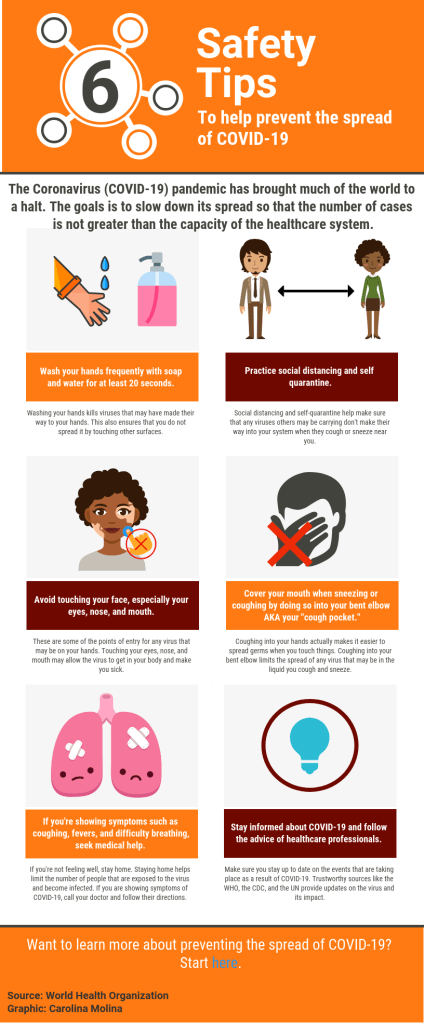
Ways To Prevent The Spread Of COVID-19

COVID-19, also known as the Coronavirus, has brought the world to a halt as the number of confirmed global cases has risen to 167,511 as of March 16. The outbreak was declared a pandemic by the World Health Organization on March 11.

While COVID-19 may not have serious effects on young, healthy people, it does have severe impacts on those who have underlying health issues, respiratory problems, as well as the elderly. Those who are immunocompromised are at a higher risk of getting COVID-19.

The United States declared a national emergency given the fast spread of the virus. Universities moved their courses to be taught online, public schools have closed, professional sports have been postponed or cancelled, and people have been urged to stay home as much as possible.

These steps have been taken to ensure that the number of cases that require medical attention do not surpass the capacity of the healthcare system. This infographic shows some of the ways we can help slow down the spread of COVID-19.

Is The Nearest Police Station Actually That Close?

The Chicago Police Department has 23 police stations located throughout the city. At first glace, the stations seem to be spread out and there doesn’t seem to be a significant concentration of stations in a single area.

According to an analysis of data from the City of Chicago Data Portal, however, it can be seen that there are several neighborhoods such as Avalon Park, Humboldt Park, and Brighton Park that are within gaps that don’t have police stations nearby.

Most of the city’s 23 police stations are located on the North and downtown parts of the city. Moving further towards the South Side, it can be seen on the interactive map that the locations of these stations become more sparse.

Are 23 police stations enough for a city as large as Chicago?

Map By: Carolina Molina | Source: City of Chicago Data Portal

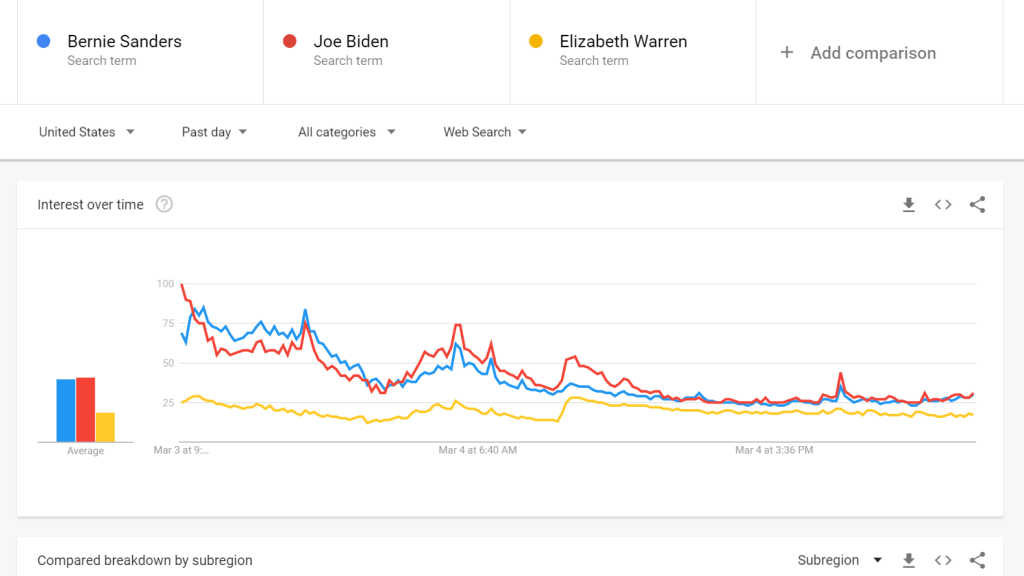
Google Trends: Joe Biden and Bernie Sanders Trending On “Super Tuesday” and America’s Top Streaming Services

Bernie Sanders and Joe Biden Close Super Tuesday With Similar Search Trends

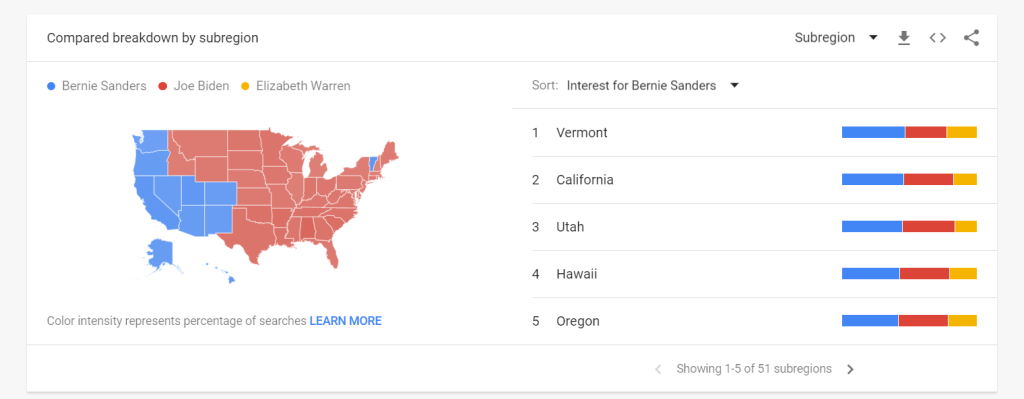
Former Vice President Joe Biden, Vermont Sen. Bernie Sanders, and Massachusetts Sen. Elizabeth Warren were popular searches among Americans on Super Tuesday. Given the day’s importance in the Democratic primaries, this graphic is a good way to gauge which candidates have the public’s attention.

According to an analysis of google search data, Sanders started the day as the most searched out of these three Democratic candidates. As the day progressed, however, Biden took over as the most searched. The day came to a tight close between Biden and Sanders while Warren remained the least searched for out of the three.

This reflects the results of the Democratic primaries as Biden has won 566 delegates, Sanders has won 501, and Warren has won 61 delegates. 

Although Biden seems to dominate searches throughout most of the country, Bernie is still a serious contender. Yet with the race so tight between Biden and Sanders, not much room is left for Warren.

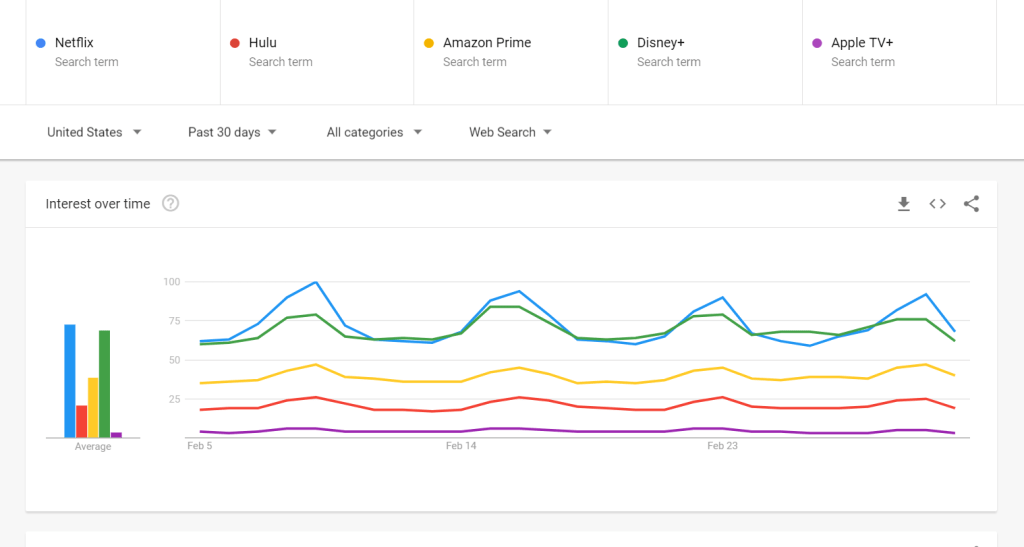
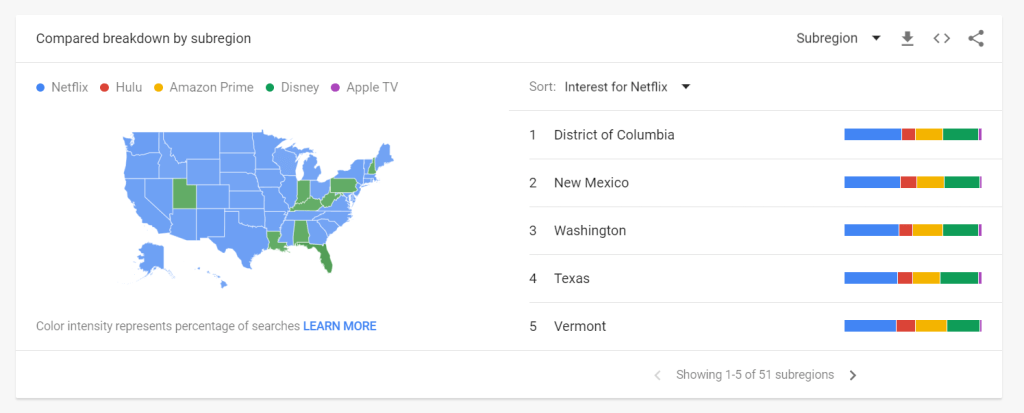
Netflix Has Some Serious Competition With Disney+ On The Rise

Netflix has long reigned over the entertainment industry. With some manageable competition from Hulu, Amazon Prime, and Apple TV+, Netflix still holds the No. 1 spot in popularity with the general public. With a recent rise in popularity for Disney+, however, that may change.

According to an analysis of google search data, Netflix and Disney+ are quite close in being the most searched for streaming service with Disney+ surpassing Netflix on several occasions. Trends for each streaming service show that searches for each one peaks on Sundays, but Disney+ has managed to surpass Netflix several times over the last month as it holds interest throughout the week.

Netflix introduced its streaming service back in 2007 while Disney+ was launched at the end of 2019. Since then, Netflix and Disney+ have both been very close in holding interest from potential subscribers as they are searched for using Google. 

All five streaming services have original content exclusive to each individual service. Even with award winning series and films from each service, Netflix remains the most search for throughout most of the United States.

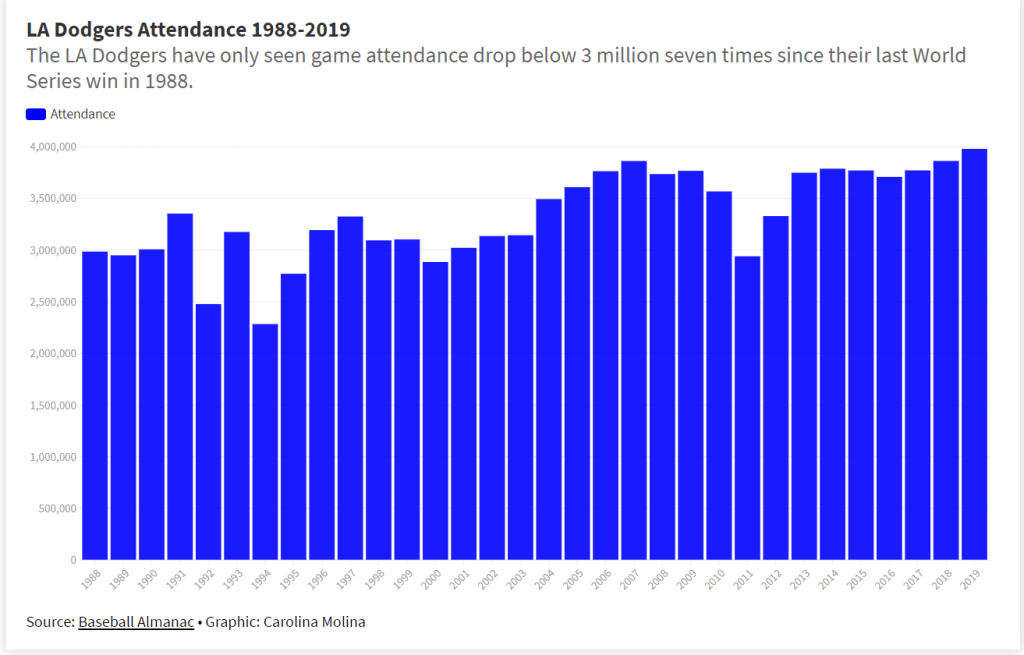
The Los Angeles Dodgers Game Attendance 1988-2019

The Los Angeles Dodgers baseball team has had great support and attendance from their fans despite not having won a World Series game since 1988. As the interactive chart below shows, the team has only seen an overall seasonal drop in attendance below 3 million seven times over the last 31 years.

The drop in attendance seen in 1992 can be attributed to the team’s disappointing season having lost 99 games as well as the 1992 L.A. riots that resulted in three game cancellations. Even so, attendance again picked up in 1993.

In 1994, when attendance again dropped below 3 million, the MLB was experiencing a strike to resist salary caps that lasted 232 days. The baseball season ended early and resulted in the World Series being called off. Attendance rose steadily until it again exceeded 3 million in 1995.

The drop in attendance in 2011 coincides with the turmoil brought to the team by the then owner of the franchise, Frank McCourt. The Dodgers filed for bankruptcy and were eventually bought by the Guggenheim Baseball Partners.

The Dodgers have kept their seasonal attendance above 3 million since 2011.

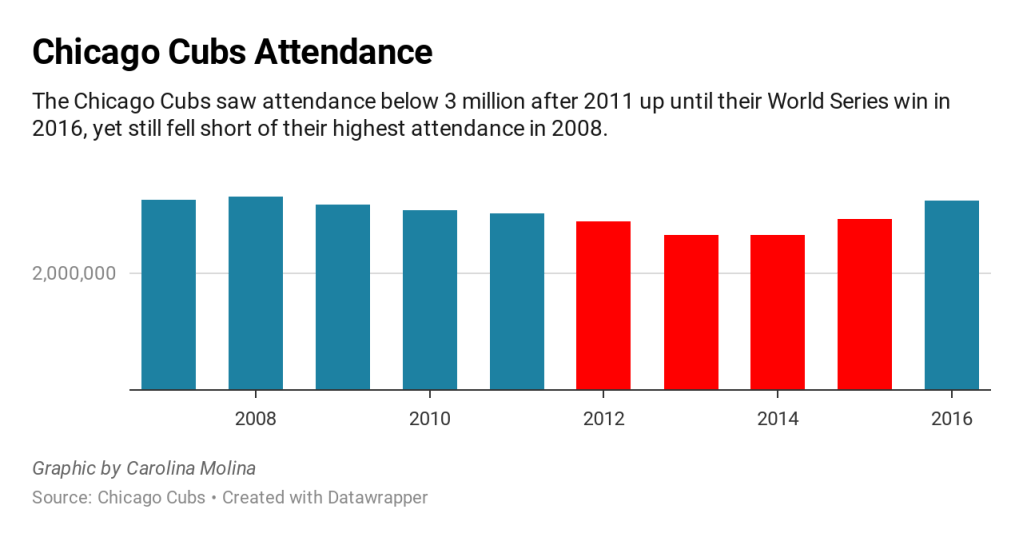
Chicago Cubs Attendance From 2007 to 2016

This interactive graphic shows the attendance at Chicago Cubs baseball games from 2007 to 2016.

The Chicago Cubs had been named the “lovable losers” prior to their 2016 World Series win. As such, loyal Chicago Cubs fans still enjoyed attending baseball games at Wrigley Field.

In 2012, however, attendance at the games fell below 3 million. Attendance had not fallen below 3 million since 2003. The team’s performance in 2012 was not great, a trend that left their attendance below 3 million for 4 years.

The rise in attendance seen in 2015 can be attributed to the team’s advancement to the NLCS with an impressive 97-65 record. The Cubs were still just short of ending their 108-year-old World Series championship drought – a feat they would achieve in 2016 when attendance nearly rose to their all time high of 3,300,200 in 2008.

Google Trends: America’s Most Popular Streaming Services and Australian Fires Peak American Interest In Climate Change

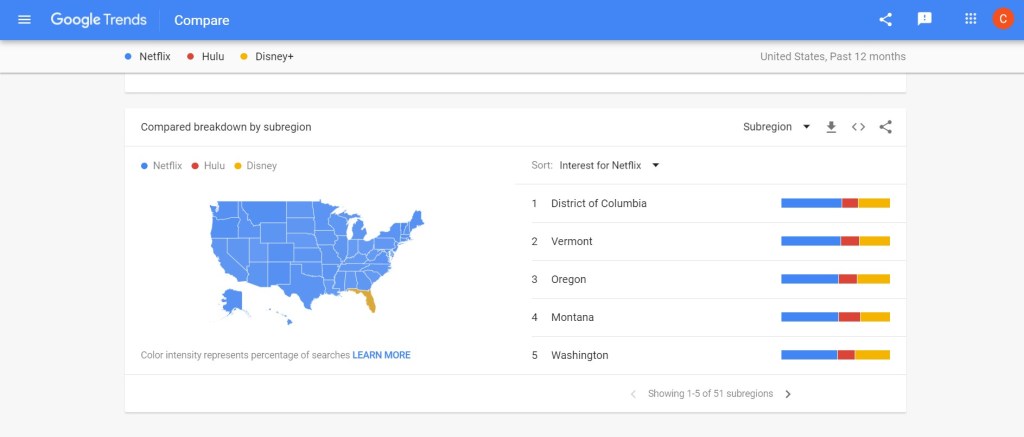
Netflix Comes Out On Top When Compared To Other Streaming Services

Netflix, Hulu, and Disney+ have taken over the entertainment industry. All three streaming services provide users with a library of films and series including exclusive original content produced by each company.

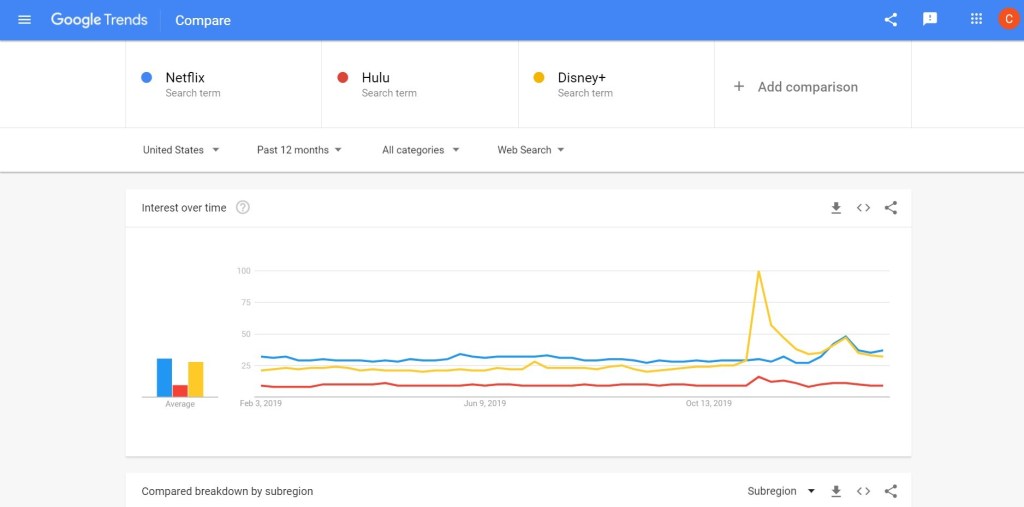
Netflix was founded in 1997 by Reed Hastings and became popular after the company introduced its streaming services in 2007. In the past decade there have been several competing streaming services that have been launched including Hulu and Disney+, yet in the past year, Netflix has been searched for more than any other service in every state except Florida according to a Google Trends analysis.

Hulu and Disney+ were launched years after Netflix, the former in 2008 and the latter in 2019, and are both owned by The Walt Disney Company. Even though both services offer bundle deals to save users money, it can be seen on both graphs that for the last year, Netflix has remained the most popular streaming service in the United States.

Having been the most popular streaming service for years, Netflix was overshadowed for a short period after the launch of Disney+ on November 13th, 2019. Since that launch, the trends for the searches of either streaming service have been very similar with Disney+ staying at a close second for most searched.

Australian Bushfires Peak American Interest in Climate Change

The bushfires in Australia have been devastating for wildlife as the death toll is estimated to be at more than 500 million and hundreds of residents have been displaced and their homes destroyed.

Climate change has been been cited as a reason for the severity of the fires given the hot and dry conditions Australia dealt with prior to the fires.

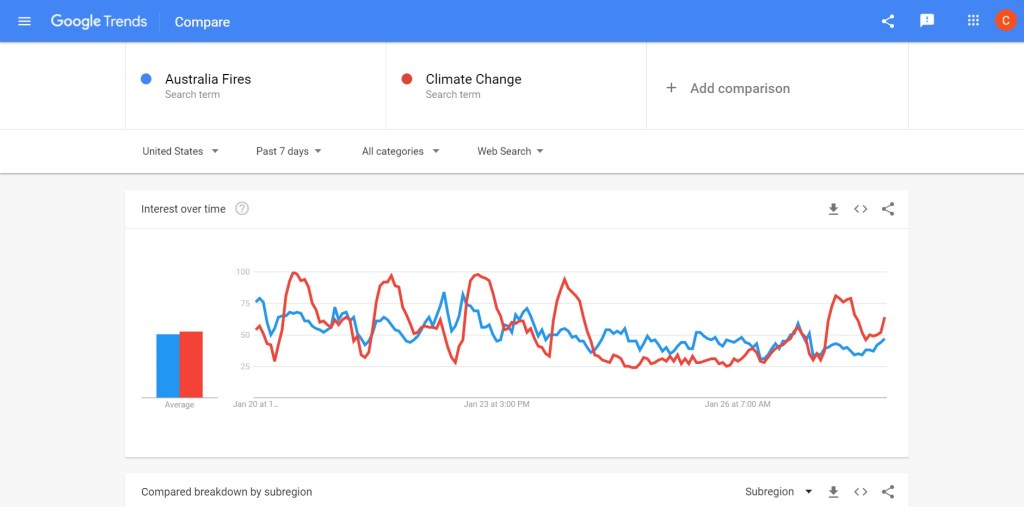
The fires became international news with aid and support coming from around the globe. Americans took to Google to get news regarding the Australian fires as well as information on climate change according to a Google Trends analysis.

The graph illustrates the spikes in American Google searches for both climate change and the Australia fires for the past 7 days. Americans appear to be making the connections between both the fires and climate change statistics as more celebrities and influencers encourage their fans to inform themselves about the effects of climate change.

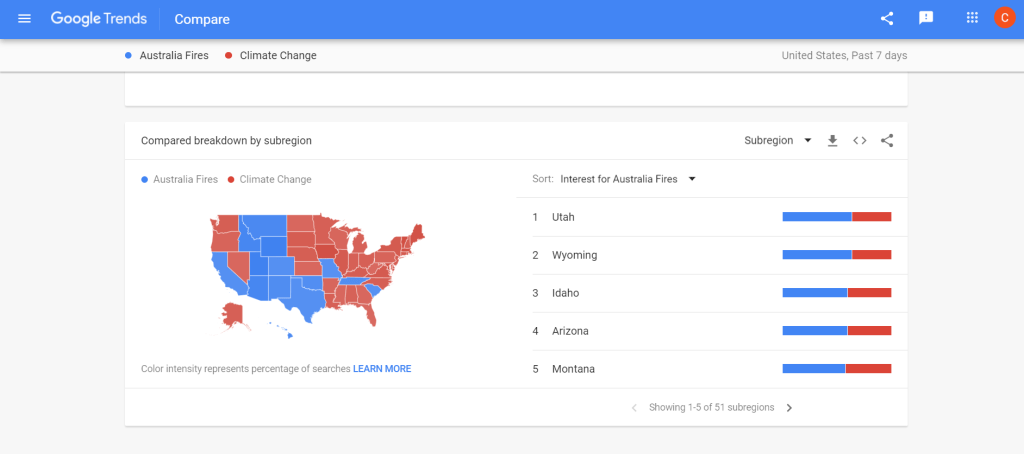
The map gives the public an idea of which states searched for one topic more than the other while also showing how close the interest over time was between the two. The boom in Google searches does not come long after the American President, Donald Trump, opposed environmental activist, Greta Thunberg, on the legitimacy of climate change.

Quinn: Pensions Threatening MAP Grant Program

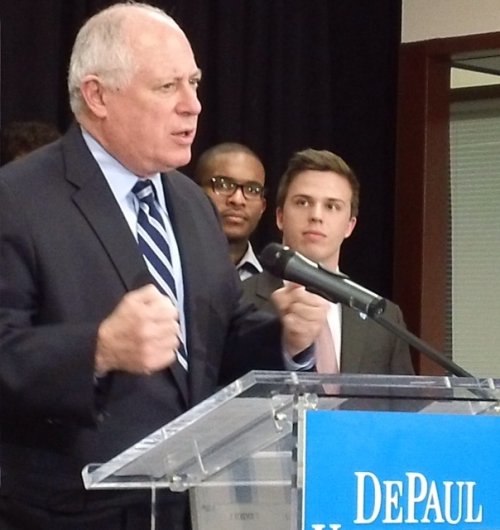
Gov. Pat Quinn talks about MAP grants at DePaul University. (Photo by Josclynn Brandon)

Editor’s note: This story was originally posted on Dec. 12, 2012 and is housed at RedLineProject.org

By Bob Smith

Gov. Pat Quinn visited DePaul University’s Loop campus on Wednesday to discuss how pension reform is harming the Monetary Award Program (MAP) college scholarships and access to higher education in Illinois.

“This is so important to our state, not only in the past, but certainly now and in the future,” Quinn said.
“We want everyone to have the opportunity to go to college that has the ability to go to college.”

MAP grants are need-based college scholarships that allow merit students who are in need across the state and do not need to be repaid by the student. Quinn said that due to cutbacks and having to pay more money in the pension amount, almost 18,000 students lost their MAP grant scholarships this year.

“We do not want anyone denied that opportunity because of finances,” Quinn said. “We can’t afford to lose all the talent that exists, all the ability that exists for higher education to help our economy and to help all of us, because there are financial challenges that deny someone the opportunity to go to community college or a four-year university — public and private — in our state.”

Quinn was joined by several Illinois college students, including DePaul Student Government Association Vice President Casey Clemmons.

“Every year over 5,000 DePaul students receive MAP grants, and just like the students who have already spoken here today, all of these DePaul students rely on this funding in order to continue their college careers,” Clemmons said.

“Because the number of Illinois students eligible to receive MAP is currently increasing, existing funding does not allow the state to assist all the eligible students. As a result, without action by the Illinois state leadership, more DePaul students than ever will see their MAP funding disappear this year and more

DePaul students than ever will be forced to give up their education due to finances.”

More than 150,000 students nationally receive MAP grants each year.

Clemmons told the audience that on Tuesday, DePaul’s SGA unanimously passed a resolution calling on the Illinois general assembly and the governor to ensure the longevity of the MAP program.  He read the resolution aloud and presented a copy to Quinn. 

Ken Thomas, a University of Illinois Board of Trustees student member, MAP recipient and University of Illinois Chicago student, told how he wouldn’t be where he is today if it wasn’t for the MAP grant.

“My mom, when I was in high school, had to work two jobs just to keep food on the table,” Thomas said, “and if we didn’t have [the] MAP program like we do today, I know that I wouldn’t be where I am today; graduating with a degree, hoping to be a productive member of society.” 

Having a productive and functioning society and economy is what Quinn says it’s all about.

“Jobs follow brainpower,” he said. “We want to make sure we have smart people in Illinois. Well skilled, well-educated students coming out of college with graduate degrees and diplomas so they can create jobs, create new businesses,” he said. “Our goal in Illinois is to have at least 60 percent of the adults in our state with a college degree or college associate degree or career certificate by the year 2025. In order to achieve we have to make sure we have a good scholarship program.”

Clemmons said that in order for that to happen, state legislatures need to reflect upon the question, “What must be done?” and do what’s required. 

Design a site like this with WordPress.com
Get started